Pope Francis says Deliberately Opposing Migration ‘Is a Grave Sin’
VATICAN CITY (LifeSiteNews) — Pope Francis condemned efforts to regulate immigration, stating that those who “systemically” work to “repel migrants” are committing a “grave sin.”
Leaving aside his series of catechetical addresses, Pope Francis today used his Wednesday audience to address the topic of immigration. “I would like to pause with you to think about the people who – even at this moment – are crossing seas and deserts to reach a land where they can live in peace and safety,” he opened.
VATICAN: #PopeFrancis spoke on immigration at audience today, didn’t distinguish betw legal & illegal:
— Michael Haynes ?? (@MLJHaynes) August 28, 2024
There are those who work systematically & with every means possible to repel migrants – to repel migrants. And this, when done with awareness & responsibility, is a grave sin. pic.twitter.com/9NELAMuh5E
‘A grave sin’
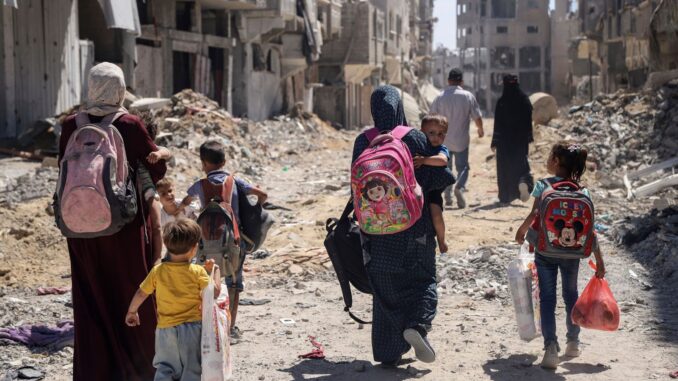
Using the themes of “seas and deserts,” Francis stated that both seas and deserts are becoming “cemeteries of migrants.” He added that “the tragedy is that many, the majority of these deaths, could have been prevented.”
Francis has often highlighted the topic of migration from the very earliest days of his pontificate.
Today’s general audience saw him amplify his already strong rhetoric as he condemned anyone who took steps to oppose migration:
It must be said clearly: There are those who work systematically and with every means possible to repel migrants – to repel migrants. And this, when done with awareness and responsibility, is a grave sin.
Elaborating on his description of opposing migration as being a “sin,” Francis drew on Sacred Scripture: “Let us not forget what the Bible tells us: ‘You shall not wrong a stranger or oppress him’ (Ex 22:21). The orphan, the widow and the stranger are the quintessential poor whom God always defends and asks to be defended.”
The Pontiff also pointed to a disparity between the wealth of different societies, commenting that “in the time of satellites and drones, there are migrant men, women and children that no one must see: they are hidden. Only God sees them and hears their cry. And this is a cruelty of our civilization.”
Turning to Scripture once again, Francis compared current immigration – a phenomena particularly focused into Europe from Africa and into the U.S. from the southern border – to the “great migration” of the Jewish people who were led by Moses out of slavery in Egypt.
“It will be good for us today: the Lord is with our migrants in the mare nostrum, the Lord is with them, not with those who repel them,” Francis commented.
The Pope did not distinguish between legal and illegal immigration during his audience address, or on the manner in which immigrants should be welcomed and acclimatize to the local culture – an aspect on which the Church has clear teaching. His words appeared to be a general invitation for increased immigration of any kind.
Open borders and Catholic social teaching
Italy has been facing a spiraling migrant crisis for many years due to the mass influx of individuals into the country, chiefly from African Muslim nations. The harbor town of Lampedusa is a popular destination for such migrant boats due to its position in the far south of Italy, and it is increasingly being overrun by Muslim immigrants. It was here that Pope Francis made his first trip outside of Rome in July 2013.
READ: Catholic priest ambushed, stabbed multiple times in ‘frenzied’ attack
With much of Europe now seeing a marked increase in violence linked to illegal immigration, often by Muslims, Francis has nevertheless continued to issue a call for more immigration rather than less.
Addressing the audience in St. Peter’s Square on Wednesday, Francis said that to prevent migrants from suffering in “those lethal deserts” there should be more open borders:
But it is not through more restrictive laws, it is not with the militarization of borders, it is not with rejection that we will obtain this result. Instead, we will obtain it by extending safe and legal access routes for migrants, providing refuge for those who flee from war, violence, persecution and various disasters; we will obtain it by promoting in every way a global governance of migration based on justice, fraternity and solidarity. And by joining forces to combat human trafficking, to stop the criminal traffickers who mercilessly exploit the misery of others.
The Catholic Church’s teaching regarding immigration is a careful mix of charity to the citizens of a nation and those seeking entrance to that nation for just reasons. The Catechism notes that “political authorities, for the sake of the common good for which they are responsible, may make the exercise of the right to immigrate subject to various juridical conditions, especially with regard to the immigrants’ duties toward their country of adoption.”
READ: Memorial for slain Father Hamel is a reminder that violent terrorist attacks continue in France
Furthermore, the Catechism outlines that “immigrants are obliged to respect with gratitude the material and spiritual heritage of the country that receives them, to obey its laws and to assist in carrying civic burdens.”
Such a teaching was expounded upon in 2011 by Pope Benedict XVI in his message for the 97th World Day of Migrants and Refugees. While quoting from Pope John Paul II to defend the “possibility” for people “to enter another country to look for better conditions of life,” Benedict also defended the rights of the home nations to restrict such entries:
At the same time, States have the right to regulate migration flows and to defend their own frontiers, always guaranteeing the respect due to the dignity of each and every human person. Immigrants, moreover, have the duty to integrate into the host Country, respecting its laws and its national identity.
Indeed, prior to this, John Paul II wrote for the same occasion in 2001 that the exercise of the “right to emigrate … is to be regulated, because practicing it indiscriminately may do harm and be detrimental to the common good of the community that receives the migrant.”
READ: EU elections turn ‘sharp right’ as immigration woes wreak havoc in Europe
Papal praise for Mediterranean project
Concluding his Wednesday audience, Pope Francis praised the “courageous men and women” who “do their utmost to rescue and save injured and abandoned migrants on the routes of desperate hope, in the five continents.”
He included the organization Mediterranea Saving Humans (MSH) among those he described as being “on the front line” in the “fight for civilization.” In recent days, the scandal-encircled organization embarked on another trip to bring illegal immigrants to Italy, and for the first time did so in conjunction with the Italian Catholic bishops’ conference.
Pope Francis sent a handwritten note praising the endeavor.
READ: Italy’s bishops giving millions to papal confidant’s illegal immigration scheme: report
MSH’s ship “Mare Jonio” has previously been confiscated and fined over disputes with the local authorities regarding their bringing illegal refugees to Italian ports.
Scandal erupted last December when it was reported that controversial activist Luca Casarini – personally invited to the Synod on Synodality by Francis – has had his activity supporting illegal immigration heavily bankrolled by the Italian bishops.
Casarini works with MSH, and the group’s chaplain has been identified as a key link between Italian bishops’ conference president Cardinal Matteo Zuppi and a recent increase in funding from the Italian episcopate.
Taxpayer-Funded AI Targets Vaccine Skeptics in Social Media Surveillance

Preferred information about actual medical inoculation is now being protected by – more “inoculation.”
This latter form is proliferated via an “AI” (machine learning) tool against “misinformation” about vaccines.
It is the US Department of Health and Human Services (HHS) – or rather, US taxpayers – that is funding this effort.
The University of Pennsylvania is the recipient of the $4 million covering the period from April 2022 until March 2027, used to conduct a randomized trial called “Inoculate for HPV Vaccine” and produce the said tool.
This information came to light thanks to the Children’s Health Defense (CHD) freedom of information request to gain access to grant documents.
Associate professor of nursing at the University of Pennsylvania Melanie L. Kornides heads the team behind the study. Kornides “specializes” in researching vaccine uptake and anti-misinformation strategies, while others taking part in this project are software developers, machine learning and communication experts, and social media analysts, reports say.
Their task is to scour YouTube, Twitter, Facebook, and Instagram for user data, and create an “inoculation tool” to pinpoint “HPV vaccine misinformation” as well as content expressing vaccine skepticism – “whether or not the information in the post is true or false.”
What these researchers themselves have said about how the tool can be used is of particular interest – HPV vaccines aside, it can allegedly be repurposed to identify “misinformation” about a range of issues, such as Covid and cancer treatment. And this can be done “swiftly and efficiently.”
Meanwhile, the “AI tool” will be developed through trials involving one control and two test groups that will be “inoculated” against criticism of the HPV vaccine, or with messages that criticize those opposed to vaccines.
To make sure the subjects are adopting the desired way of thinking, the experiment will involve exposure to “booster messages” at several intervals.
HHS is funding other similar research efforts, again with the HPV vaccine in mind, and focused on promoting messaging in favor of broader uptake on social media – but as this project shows, the “tools” created for this purpose can be used in other scenarios.
CIA Admits to ‘Conversations’ Over Ukraine’s Incursion into Kursk Region

Ukraine’s cross-border incursion into Kursk Region, Russia will likely continue “for some period of time,” CIA Deputy Director David Cohen told the Intelligence and National Security Summit on Wednesday.
Kiev launched a surprise raid into Russia earlier this month, deploying up to 10,000 troops armed with Western-supplied heavy weapons. The Ukrainian army has seized some border areas, resulting in the deaths and injuries of dozens of civilians, but it has failed to advance deeper into Russian territory.
Ukraine reportedly did not consult its Western sponsors before launching the operation, leaving them puzzled over its ultimate goals.
Speaking on Wednesday, Cohen declined to answer a direct question about whether he and his colleagues at Langley were just as “surprised” by Ukraine’s incursion, noting that the significance and implications of the attack “remain to be seen.”
READ MORE: US hesitant over Kursk incursion aid – WaPo
“They are remaining in Russia, building defenses, and, as best as we can tell from our conversations, there seems to be intent on retaining some of that territory for some period of time,” Cohen stated, without elaborating on what those conversations entailed.
Cohen went on to say that Ukraine’s attack “has the potential to change the dynamic” of the conflict going forward, but he admitted there is no doubt that Russia “will mount a counteroffensive to try to reclaim that territory.”
“I think our expectation is that this will be a difficult fight for the Russians,” he added. “It’s still early days in this, so we’ll have to see how it all plays out.”
READ MORE: Ukraine’s top general admits key Kursk failure
The Ukrainian leadership has been inconsistent in explaining its goals for the Kursk Region operation. Initially, Vladimir Zelensky’s office stated that capturing Russian territory was necessary to gain a stronger position during eventual peace talks with Russia. It also mentioned the need to apply pressure on Moscow by intimidating the Russian public into accepting Ukrainian terms.
The messaging later shifted, with Zelensky declaring the creation of a buffer zone as a key achievement. Last Saturday, he claimed that the incursion had preempted a Russian attempt to enter Ukraine’s Sumy Region from Kursk.
Russian President Vladimir Putin has said that the incursion and the harm it caused to Russian civilians have made negotiations with Ukraine impossible. Previously, he offered a ceasefire in return for political and military concessions.
Steve Kirsch: Medical Genocide Alert— Czech Republic National Database Confirms COVID Injections Causing Massive Increase In Death

Steve Kirsch joins Alex Jones live to break down the latest research that confirms what we already knew: the COVID jabs are killing us softly.
Steve Kirsch: Medical Genocide Alert— Czech Republic National Database Confirms COVID Injections Causing Massive Increase In Death@stkirsch pic.twitter.com/A8VeCfezzg
— Alex Jones (@RealAlexJones) August 28, 2024
Australian Senator Challenges WHO: ‘We Don’t Believe Anything You Say About Monkeypox’

The people of the world no longer believe anything the World Health Organization is saying about infectious disease, according to Australian Senator Malcolm Roberts who delivered a powerful and timely message to the globalist organization […]
The post Australian Senator Challenges WHO: ‘We Don’t Believe Anything You Say About Monkeypox’ appeared first on The People’s Voice.
The Incursion Into Russia Will Not Solve Ukraine’s Biggest Problem
Earlier this month, Ukrainian forces crossed their northern border and entered Russian territory. The Ukrainians quickly took village after village as the Russian troops stationed in this Kursk region were sparse, often conscripted, and in some cases even unarmed.
Ukraine claimed to have captured over 400 square miles of Russian territory. Top Ukrainian officials and many of the staunchest supporters in Western media celebrated the operation as a major embarrassment for Vladamir Putin and a much-needed revival for Ukrainian morale.
But as the shock of the surprise offensive wore off and the Ukrainian gains on the ground slowed to a halt, Western foreign policy analysts were left guessing as to what exactly the strategic objective was for the incursion.
The Ukrainians officially claim it is an attempt to establish a buffer zone to minimize cross-border rocket attacks in the region, but that explanation has not been widely accepted by foreign policy experts. Some think the operation was meant to show Ukraine’s Western backers that they can still win battles in order to keep the money and weapon transfers coming. Others think the main point was to hurt Putin’s credibility with the Russian public.
For those of us calling for negotiations, this looked like it might be a last-minute attempt to scrape back some leverage over Russia before entering into talks. In the twenty-eight months since the West convinced Ukrainian President Volodymyr Zelensky to walk away from peace talks in the weeks after Russia’s 2022 invasion, Ukraine’s position in future talks has grown weaker and weaker.
First, in September of 2022, the Russians laid permanent claim to tens of thousands of square miles of Ukrainian territory that it had earlier agreed to relinquish.
There was an opportunity in November of 2022 when Ukraine launched a surprise attack and recaptured the southern city of Kherson. And, while their position was still weaker than in the spring of 2022, the victory was likely the best opportunity Ukraine would have to transition to talks, as former chairman of the Joint Chiefs of Staff Mark Milley said at the time.
It did not happen. Instead, we were told a massive counteroffensive would kick off last summer to drive Russians out of much of the territory they controlled. When the time came, however, the Ukrainians struggled to break through heavy Russian minefields and, in the end, they lost more territory than they had gained. Since then, Ukraine’s position has grown even more precarious as its supply of soldiers dwindles.
Over the past months, the war has entered a somewhat stalled state as Russia hunkered down and banked on Ukraine’s faster rate of attrition—all while hawks in American media argued, absurdly, that Ukraine just needed more money and weapons to get out of a rut caused by a shortage of manpower. Ukraine had little to no leverage and was running out of time.
So it would make sense for Ukraine to try and switch things up now with an operation like what we’re seeing play out in the Kursk region. At best, the Ukrainians intend to transition to peace talks, but wanted to first grab some territory that they could use to wring concessions out of the Russians.
That would, at least, signal that the Ukrainians are open to negotiations, but it also seems unlikely to work. In order for this land grab to successfully extract concessions, the Russians must be convinced that the best way to regain their lost territory will be through talks, rather than with force. And right now, it’s clear that they are not convinced of that.
Currently, the Russians are mobilizing reserve troops to recapture the land lost in Kursk and have launched some devastating strikes on the Ukrainian supply lines supporting the incursion. They have also escalated their attacks on the main front to take advantage of Ukraine’s diversion of troops to Kursk. Although the Russians were caught off guard by the Ukrainians’ move, they are quickly regaining the momentum.
So if the objective of the Kursk incursion was intended to strengthen Ukraine’s position in future peace talks, they may once again be in a position where waiting only worsens their standing. American officials ought to reverse their terrible decision from two years ago and encourage the Ukrainians to finally push for peace talks with the Russians.
And if the intentions behind the incursion are worse—as comments by Zelensky, arguing that because Russia has not launched nuclear attacks after fighting spilled into their territory, the West can and should help the Ukrainians launch attacks deeper into Russia, suggest—that is all the more reason for Washington to regain control of its proxy and put an end to this horrific, unnecessary war.
BREAKING: Dr. Peter McCullough Joins Alex Jones In-Studio To Discuss Shocking New Developments Concerning The COVID-19 Injections